Research

My research focuses on developing statistical and computational methods for complex scientific problems, with emphasis on uncertainty quantification, calibration, and scalable inference.

Calibration and UQ

Bayesian methods Gaussian process Stochastic simulation

Developing scalable methods for calibrating complex epidemiologic models and quantifying prediction uncertainty. This work combines Gaussian processes, Bayesian inference, and high-performance computing to enable efficient exploration of parameter spaces.

DDUADS HIV decision support paper

Uncertainty Aware Decision Support with Computationally Expensive Simulation Models: A Case Study of HIV Intervention Scenarios

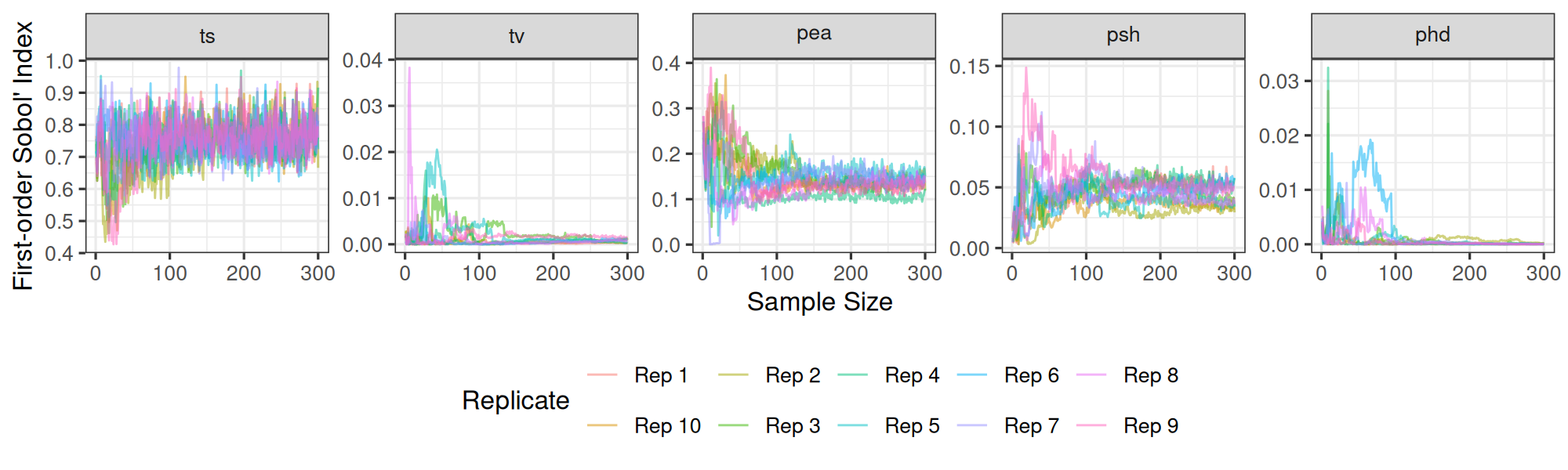
Introduces a data-driven, uncertainty-aware decision support (DDUADS) workflow that combines sensitivity screening, Bayesian calibration, and multi-surrogate integration for stochastic simulators under tight compute budgets. Demonstrated on an HIV agent-based model in Chicago to evaluate ART and PrEP disruption scenarios.

Fadikar, A., Hotton, A., Nascimento de Lima, P., Vardavas, R., Collier, N., Jia, K., Rimer, S., Khanna, A., Schneider, J., Ozik, J.

medRxiv preprint, 2026

Staying on Track: Efficient Trajectory Discovery with Adaptive Batch Sampling paper

Staying on Track: Efficient Trajectory Discovery with Adaptive Batch Sampling

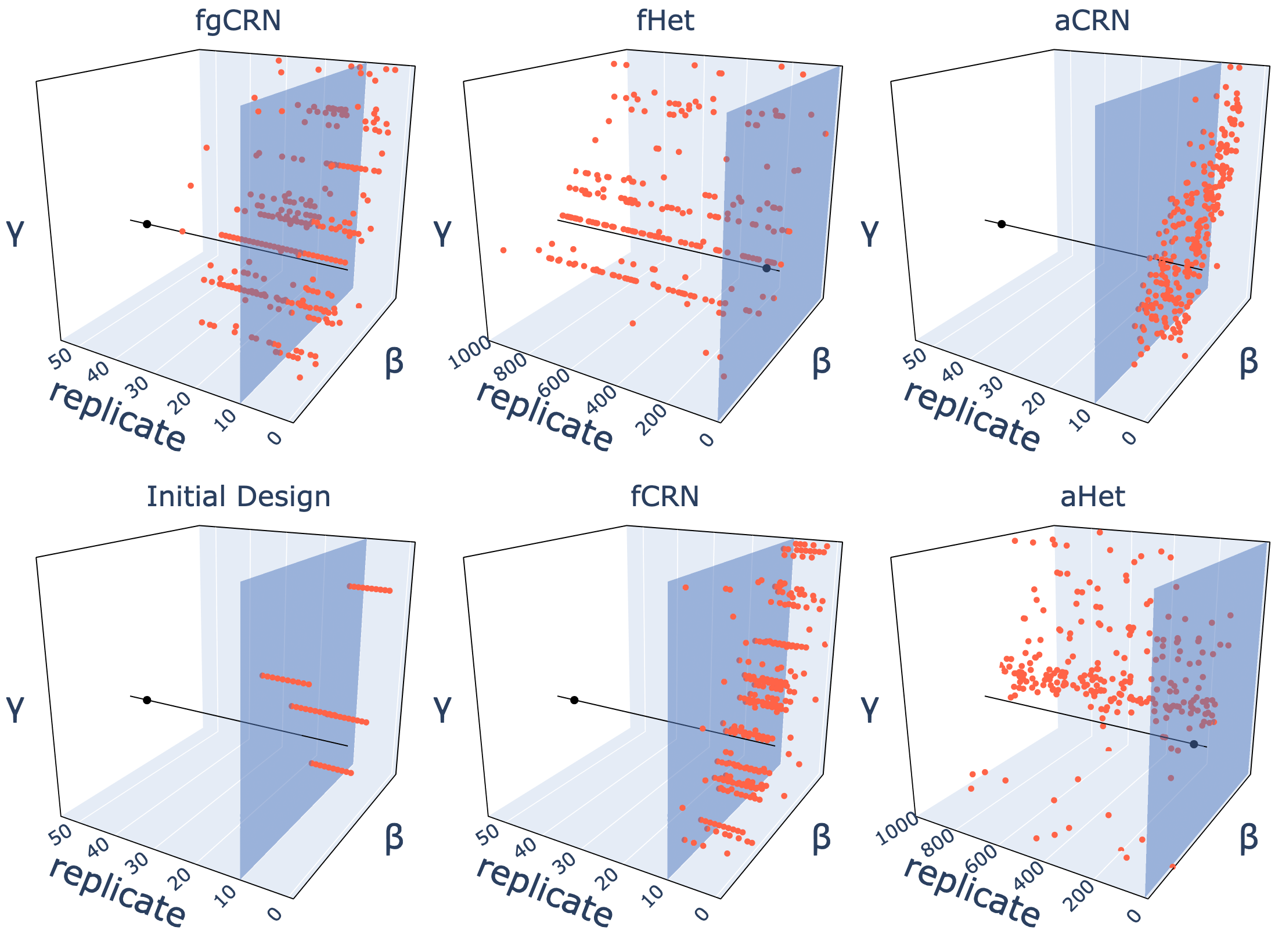
Proposes an adaptive grid-based Thompson sampling strategy for trajectory-oriented Bayesian optimization of stochastic simulators, balancing global exploration with local refinement. Discovers higher-quality trajectories with fewer expensive evaluations than fixed-grid alternatives, supporting faster uncertainty-aware calibration.

Fadikar, A., Stevens, A., Binois, M., Collier, N., Ozik, J.

arXiv preprint, 2025

Gearing Gaussian process modeling paper

Gearing Gaussian process modeling and sequential design towards stochastic simulators

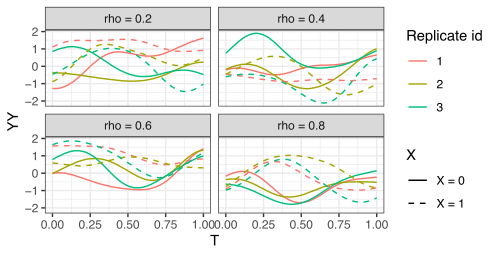
Surveys and unifies Gaussian process modeling strategies for stochastic simulators under heteroskedastic, non-Gaussian, and quantile-oriented noise. Adapts sequential design procedures — including treatment of replication — to these settings and demonstrates the methodology on an epidemiological example.

Binois, M., Fadikar, A., Stevens, A.

arXiv preprint, 2024

Show 3 more publicationsShow fewer
Towards improved uncertainty quantification paper

Towards Improved Uncertainty Quantification of Stochastic Epidemic Models Using Sequential Monte Carlo

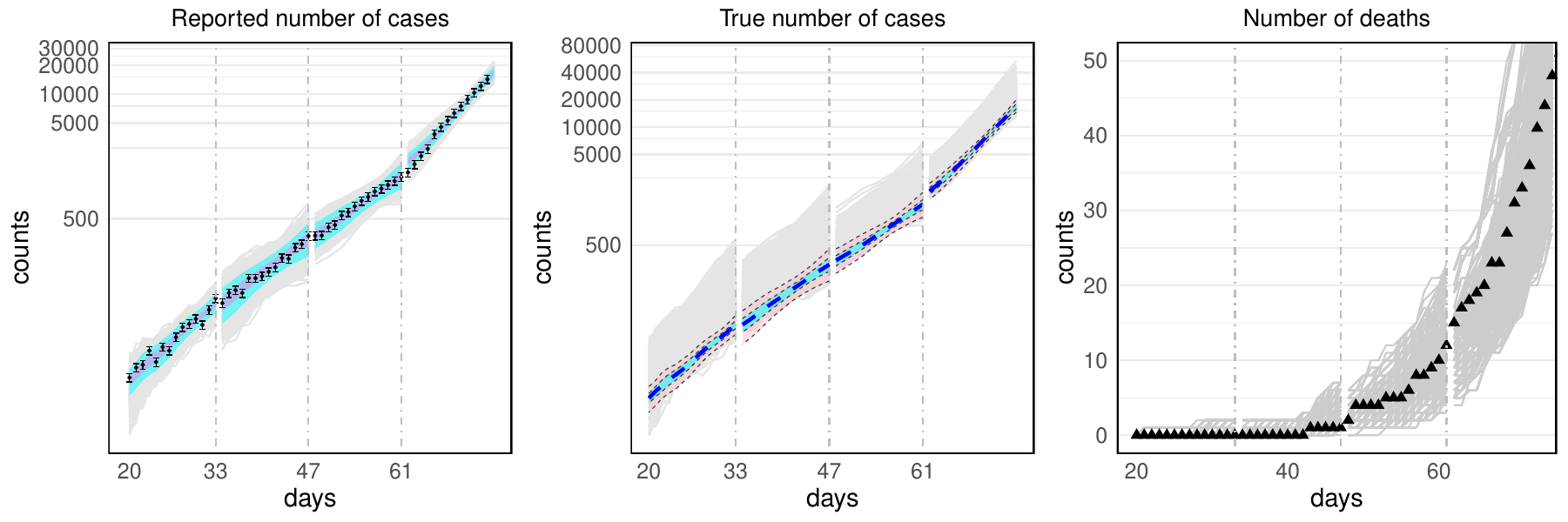
Integrates sequential Monte Carlo methods into the calibration and inference workflow for stochastic epidemic simulators. Targets robust estimation of latent dynamics under noisy simulations and imperfect observations, improving stability and interpretability of uncertainty estimates in high-variance outbreak modeling.

Fadikar, A., Stevens, A., Collier, N., et al.

IEEE IPDPSW, 2024

Trajectory-oriented optimization paper

Trajectory-Oriented Optimization of Stochastic Epidemiological Models

Frames calibration of stochastic epidemic models as a trajectory-matching problem rather than fitting summary targets. Optimization strategies tailored to noisy, computationally expensive simulation outputs improve agreement with time-varying epidemic patterns and support more realistic scenario analysis.

Fadikar, A., Collier, N., Stevens, A., Ozik, J., et al.

Winter Simulation Conference (WSC), 2023

Quantile-based emulation paper

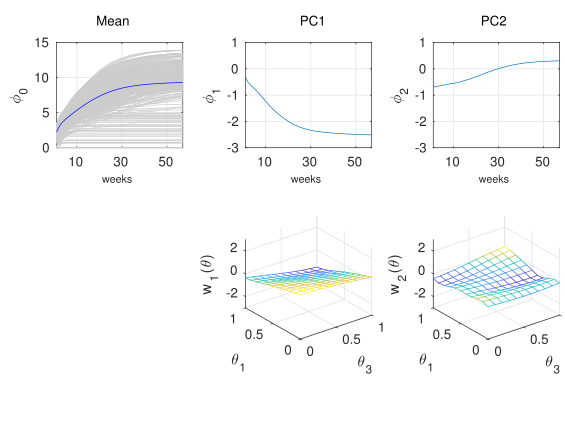
Calibrating a Stochastic, Agent-Based Model Using Quantile-Based Emulation

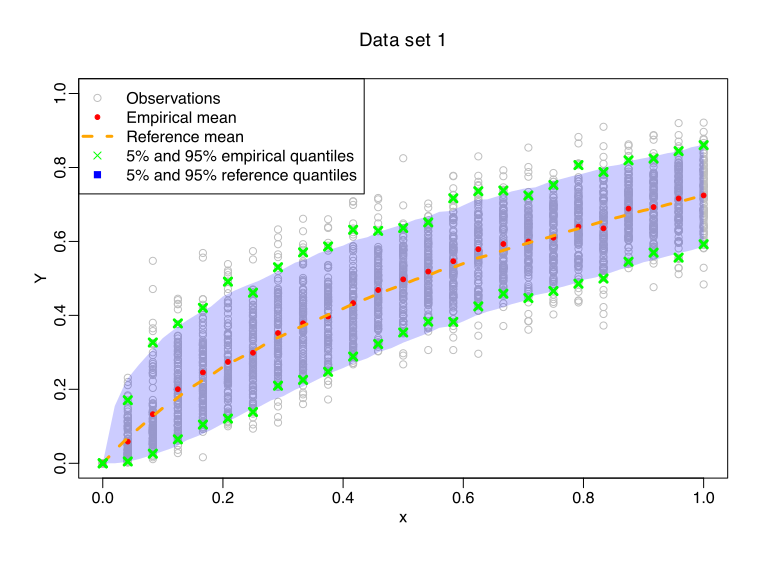
Develops a quantile-based emulation strategy for calibrating stochastic agent-based models where output variability is substantial and distributional behavior matters. Emulating informative output quantiles — not just means — yields more robust parameter calibration under heteroskedastic simulation uncertainty.

Fadikar, A., Higdon, D., Chen, J., Lewis, B., Venkatramanan, S., Marathe, M.

SIAM/ASA Journal on Uncertainty Quantification, 2018

Biostatistics

Biostatistics Epigenomics RNA-Seq

Statistical methods for high-dimensional omics data, including region-based DNA methylation analysis and robust differential expression inference under heteroscedasticity. This work emphasizes reproducibility, error control, and biologically meaningful discovery.

ReMeDy paper

ReMeDy: A Flexible Statistical Framework For Region-based Detection of DNA Methylation Dysregulation

A region-based framework that jointly models changes in methylation mean and variability, identifying differentially methylated, variably methylated, and joint mean-variance regions through a hierarchical likelihood GLM on biologically defined co-methylated regions. Controls false discovery without heuristic smoothing or kernel hyperparameters.

Chatterjee, S., Meshram, S., Arunkumar, G., Tekola-Ayele, F., Fadikar, A.

bioRxiv preprint, 2026

SACOMA paper

A spatially-aware unsupervised pipeline to identify co-methylation regions in DNA methylation data

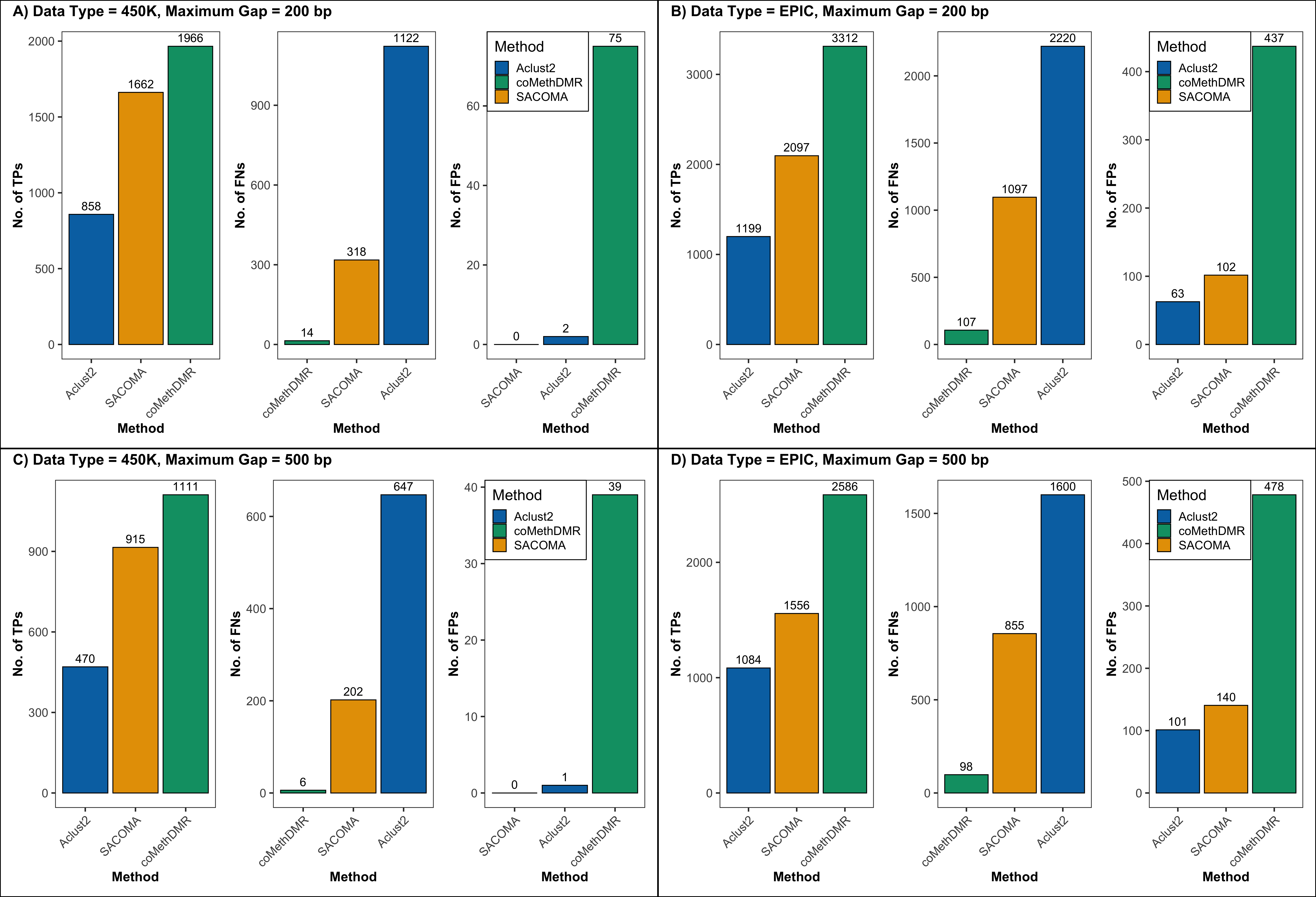
Introduces SACOMA, an unsupervised pipeline that identifies co-methylated regions in DNA methylation arrays by combining genomic proximity and methylation similarity through spatially constrained hierarchical clustering. A tunable mixing parameter avoids rigid threshold choices while maintaining strong sensitivity and false-positive control.

Meshram, S., Fadikar, A., Arunkumar, G., Chatterjee, S.

bioRxiv preprint, 2025

Robseq paper

Group Heteroscedasticity — A Silent Saboteur of Power and False Discovery in RNA-Seq Differential Expression

Identifies group heteroscedasticity as an overlooked source of false-discovery-rate inflation in RNA-Seq differential expression analysis. Combines robust M-estimation, heteroscedasticity-aware variance estimation, and Welch-type adjustments to maintain nominal error rates while preserving statistical power across realistic biological conditions.

Chatterjee, S., Fadikar, A., Hanumesh, V., et al.

bioRxiv preprint, 2024

Workflows

HPC Workflow Systems Epidemic Modeling

Building scalable workflow infrastructures for distributed model exploration, robust epidemic analysis, and reproducible scientific computing on heterogeneous high-performance platforms.

AERO paper

Automation and Collaboration in Complex Epidemiological Workflows with OSPREY

Presents OSPREY, a workflow-oriented framework for automating and coordinating end-to-end epidemiological analysis pipelines across institutions and roles. Demonstrates how structured orchestration reduces operational friction in iterative model studies and improves reliability for computationally intensive public-health workflows.

Ozik, J., Collier, N., Fadikar, A., Wozniak, J., et al.

ICPP Workshops, 2025

EMEWS paper

Distributed Model Exploration with EMEWS

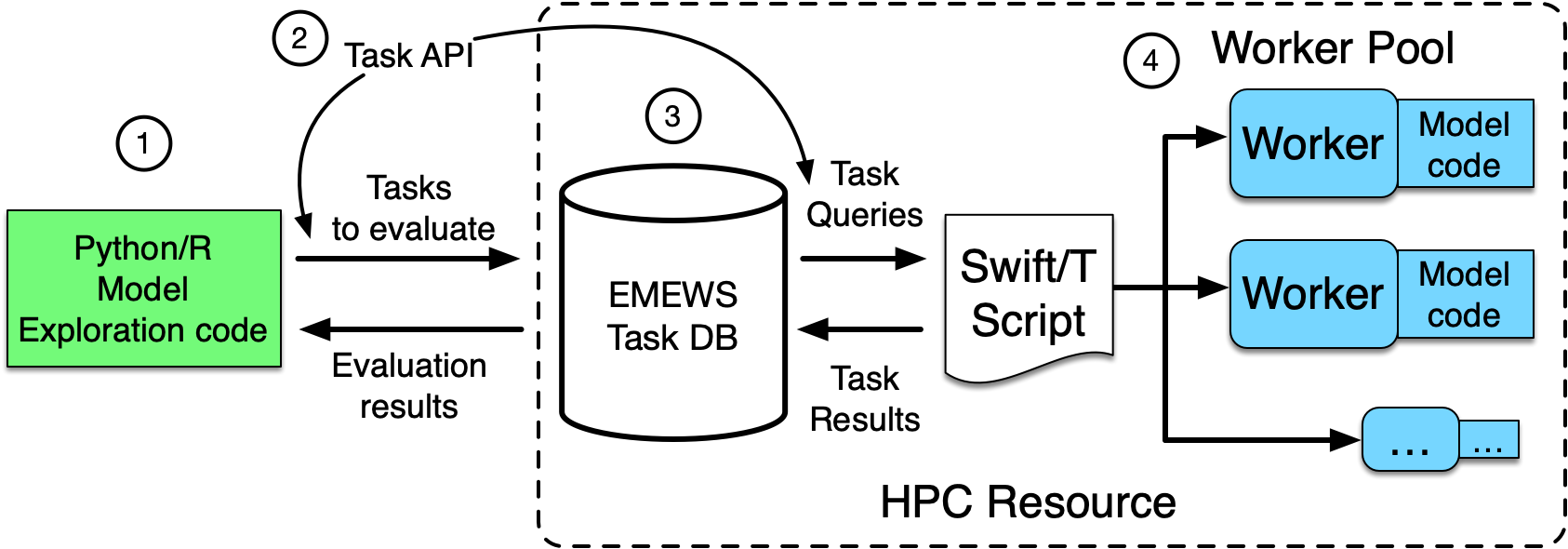
Presents EMEWS, a workflow framework that couples orchestration with high-performance and heterogeneous computing for parallel optimization, calibration, and uncertainty-aware model analysis at scale. Supports iterative, computationally expensive search procedures used in epidemiological model exploration.

Collier, N., Wozniak, J. M., Fadikar, A., Stevens, A., Ozik, J.

Winter Simulation Conference (WSC), 2024

OSPREY platform paper

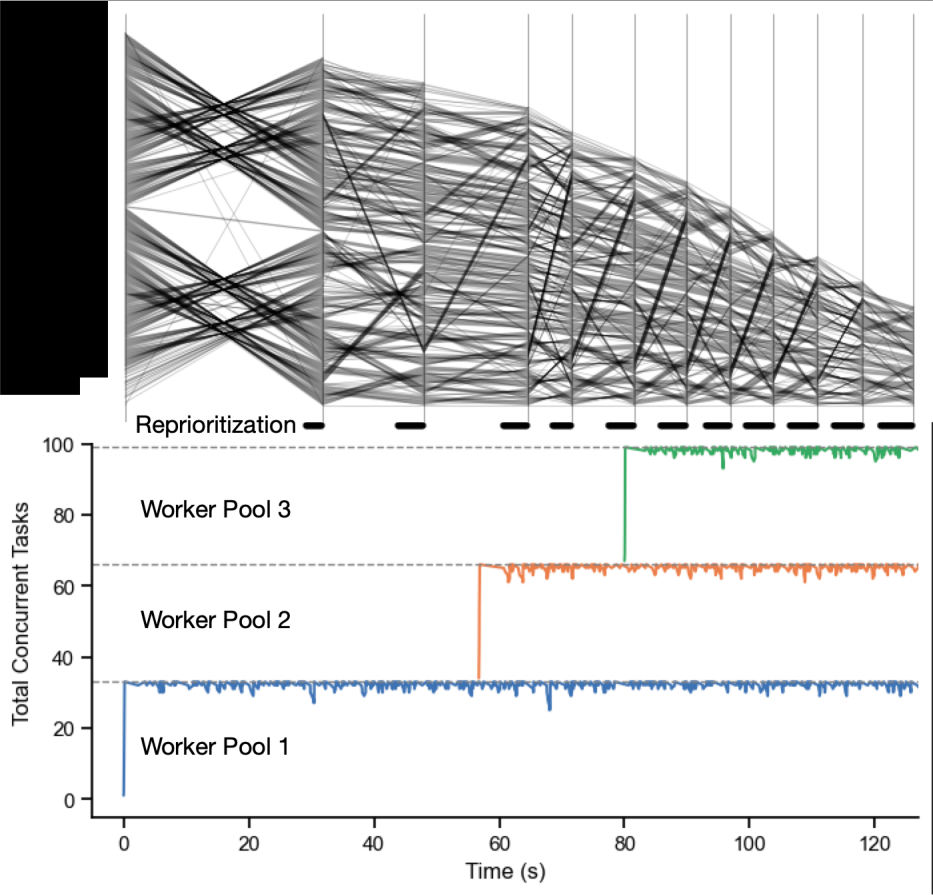
Developing Distributed High-performance Computing Capabilities of an Open Science Platform for Robust Epidemic Analysis

Describes the distributed-HPC architecture of an open science platform for robust epidemic analysis. Integrates scalable workflow execution, model exploration, and heterogeneous compute resources to improve throughput and reproducibility in collaborative epidemiological modeling pipelines.

Collier, N., Wozniak, J. M., Stevens, A., Babuji, Y., Binois, M., Fadikar, A., et al.

IEEE IPDPSW, 2023